
Understand before changing
Map the team’s responsibilities, recurring work, current pressures, and hidden dependencies before redesigning processes.
Official book page
A Practical Manual for First-Time Managers on Authority, Feedback, Delegation, and Decision Timing
A practical book for first-time managers, newly promoted team leads, supervisors, and people preparing to manage a team. It focuses on the decisions that make early authority steadier: understanding the team, setting expectations, delegating clearly, giving feedback, responding to pushback, and choosing when to act.
A new manager should understand the team before changing it, clarify ownership and expectations, establish a dependable communication rhythm, and address visible problems early. The goal is not to perform authority. The goal is to make work clearer, decisions more reliable, and responsibility easier to hold.
Amazon controls current pricing, availability, delivery, and regional purchasing terms.
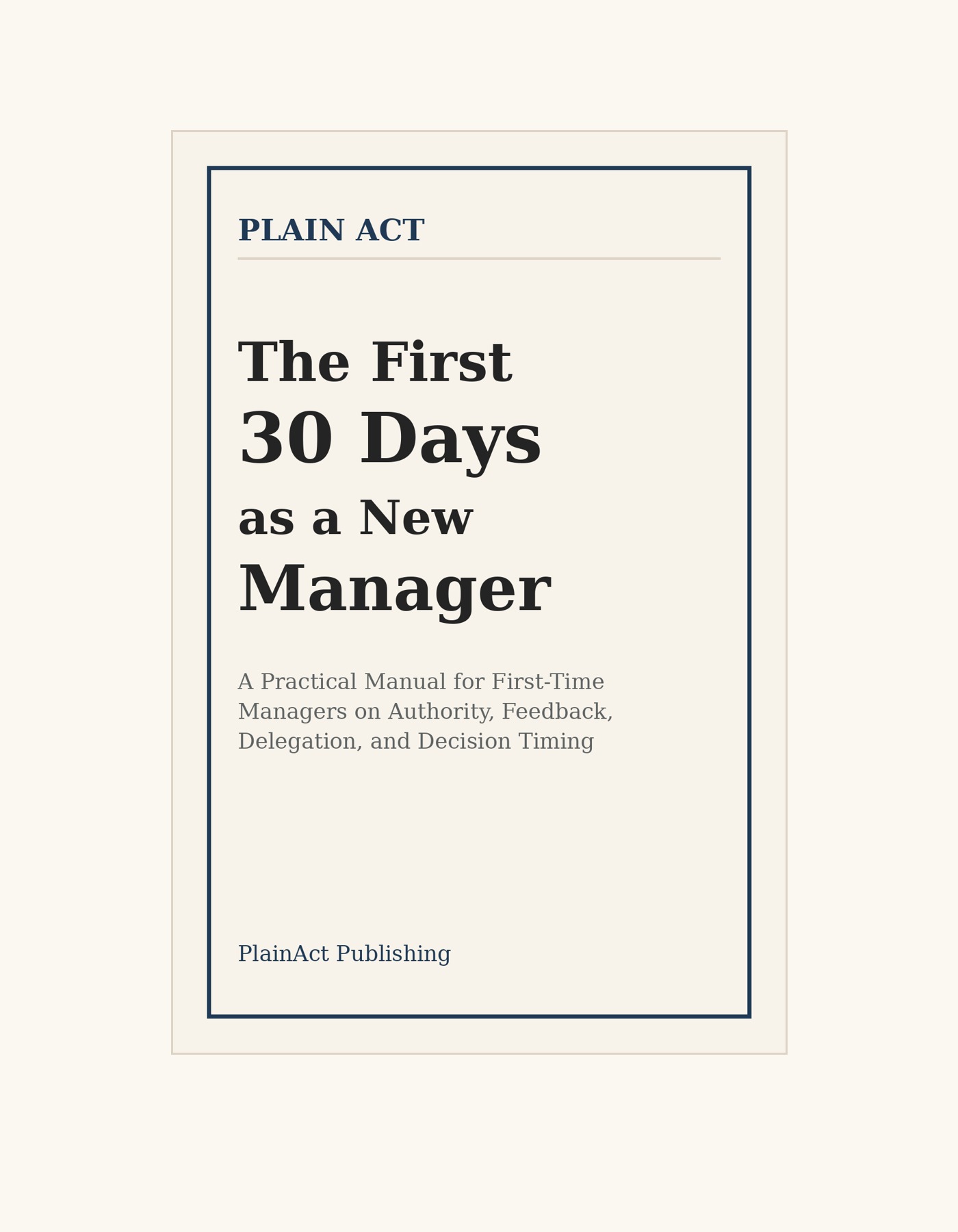
The First 30 Days as a New Manager addresses a common early-management problem: a capable professional receives formal authority, but the habits that helped as an individual contributor no longer produce clear ownership. The new manager may overexplain decisions, rescue delegated work, remain constantly available, postpone feedback, or change too much before understanding the team.
The book offers a restrained, practical approach to the first month. It works through 1:1 meetings, delegation, feedback, pushback, managing up, underperformance, boundaries, and decision timing. It is intended for readers who need usable guidance for real conversations and operating choices—not broad leadership theory or motivational performance advice.
A new manager often weakens authority not through one dramatic mistake, but through repeated reactive patterns: explaining past the point of clarity, helping past the point of ownership, committing past available capacity, delaying feedback, rescuing delegated work, staying permanently available, and changing systems before understanding them. Early authority becomes steadier when the manager replaces reaction with clear expectations, proportionate decisions, and consistent follow-through.
The book is organized around practical management behavior. The aim is not to make management look effortless; it is to help a new manager act clearly when the role still feels unfamiliar.
Map the team’s responsibilities, recurring work, current pressures, and hidden dependencies before redesigning processes.
Make ownership, standards, deadlines, and escalation points visible so people are not forced to interpret the manager’s intentions.
Use 1:1s to understand work, identify risk, clarify decisions, and address issues before they become larger problems.
Define the outcome and checkpoints, then keep responsibility with the person doing the work unless the situation genuinely changes.
Name specific behavior, explain its effect, and agree on the next expected action before frustration hardens into judgment.
Separate useful disagreement from avoidance, status testing, or repeated refusal, then answer at the correct level.
Create dependable access and escalation rules without becoming the immediate answer to every question.
Give enough context for the decision to be understood, then stop before explanation becomes a request for permission.
Create repeatable times for priorities, 1:1s, feedback, decisions, follow-up, and review so management becomes sustainable.
Kindle is suited to immediate digital reading. Paperback and hardcover provide physical reference copies for annotation, review, and returning to specific management situations.
The book is organized by days, but it is not a countdown. Each day stands on its own, allowing the reader to choose the management situation that needs attention now.
Day -1
Understand why feeling late can trigger overcorrection, overexplaining, people-pleasing, and premature change. The opening section reframes the problem before asking the reader to act.
Day 0
Lower reactivity before trying to fix performance, perception, or team systems. The aim is to stop creating new noise while clarity is still forming.
Phase 1
Build predictable authority through clearer working rules, useful 1:1s, reduced bottlenecks, and small credibility wins.
Phase 2
Work through managing up, saying no, delegation, underperformance, feedback, pushback, meetings, uncertainty, and uneven performance.
Phase 3
Address conflict, expectations, documentation, mistakes, influence, burnout, decision speed, hard conversations, trust repair, and weekly rhythm.
Readers can begin at the start or jump to the day that matches the pressure they are facing. The book is designed to be used in small, deliberate steps rather than consumed as a fixed 30-day program.
Each problem below is treated as a management situation with a practical response—not as a personality defect or a reason to perform confidence.
The problem: A new manager keeps adding reasons after a decision is already clear, often because silence feels like disapproval.
Practical principle: Explain the relevant reasoning once, invite material information, then let the decision stand.
The problem: Work is assigned, but the manager remains the hidden owner and takes it back when progress becomes uncomfortable.
Practical principle: Define the outcome, authority, constraints, and checkpoints before the work begins.
The problem: The manager waits for the perfect moment while a correctable behavior becomes an established pattern.
Practical principle: Give feedback when the pattern is specific enough to name and early enough to change.
The problem: The manager tries to prove authority through intensity, certainty, or constant intervention.
Practical principle: Build authority through clear standards, fair decisions, follow-through, and calm limits.
The problem: Disagreement, resistance, and requests for clarification are treated as though they are the same behavior.
Practical principle: Identify whether the team member is adding useful information, avoiding ownership, or refusing a reasonable expectation.
The problem: The manager accepts every request to appear helpful, then creates missed commitments and unclear priorities.
Practical principle: Connect each yes to capacity and priority; decline, defer, or renegotiate work that cannot be carried responsibly.
The problem: Concern remains private while expectations stay vague and the employee receives no usable direction.
Practical principle: Describe the gap, restate the standard, agree on the next action, and follow up at a defined time.
The problem: The manager either sends raw problems upward or hides risk until options have narrowed.
Practical principle: Bring concise context, the decision needed, the recommended action, and the consequence of delay.
The problem: The manager decides too early to look decisive or too late to avoid discomfort.
Practical principle: Match decision speed to reversibility, risk, available evidence, and the cost of waiting.
The problem: Immediate access becomes the team’s default route for uncertainty, weakening ownership.
Practical principle: Provide reliable access while requiring people to bring context, options, and a recommendation.
The problem: Management becomes a stream of interruptions because important conversations have no dependable place.
Practical principle: Create recurring moments for priorities, 1:1s, feedback, decisions, escalation, and review.
The book stays close to the early situations in which a new manager’s habits become visible. It does not ask the reader to build a leadership persona or imitate a high-energy style. It asks what the role requires in a specific moment.
That means working through 1:1s, feedback, delegation, boundaries, pushback, managing up, saying no, underperformance, decision timing, and weekly rhythm. The emphasis is on making responsibility clearer and reducing the reactive patterns that cause a manager to become the bottleneck.
For broader free education about entering management, use the Plain Act New Manager Guide. This page remains focused on the book, its framework, its intended reader, and its available formats.
A new manager should first understand the team, clarify responsibilities, establish a reliable meeting rhythm, and identify where decisions or expectations are unclear. Early authority is usually strengthened by consistency rather than dramatic change. The manager should listen carefully, address visible problems without delay, and avoid changing systems before understanding why they exist.
Yes. The book is written primarily for first-time managers, newly promoted team leads, supervisors, and professionals preparing for a formal management role. It focuses on recognizable early situations: giving feedback, delegating without taking work back, responding to pushback, setting availability boundaries, and making decisions before authority feels fully natural.
The book uses the first 30 days as a practical operating period and provides direction for what to observe, clarify, establish, and correct. It is an orientation rather than a guaranteed formula. The emphasis is on making sound decisions in sequence, because different teams have different histories, risks, workloads, and levels of trust.
Yes. Delegation and feedback are central topics. The book addresses how a new manager can define ownership, set checkpoints, resist rescuing delegated work, name performance problems early, and make the next expected action clear. The approach is practical and situation-based rather than built around broad leadership theory.
Yes. The book addresses the shift from doing the work to carrying responsibility for decisions, expectations, performance, and team rhythm. It treats authority as a matter of role clarity, fair standards, dependable decisions, and appropriate boundaries—not as a need to prove status in every interaction.
It is a practical manual. The book concentrates on early management situations such as 1:1 meetings, delegation, feedback, pushback, managing up, saying no, underperformance, availability, and weekly rhythm. It is not a motivational-performance book, a personal-branding guide, or a promise of instant authority.
The book is available from Amazon in Kindle, paperback, and hardcover formats. The official identifiers are listed on this page so readers can distinguish the formats: Kindle ASIN B0GNSXZP21, paperback ISBN-13 9798248744442, and hardcover ISBN-13 9798182137096.
The book can be purchased through Amazon. This official page links directly to the Kindle, paperback, and hardcover listings using the format URLs maintained in the Plain Act book data. Availability, delivery, and retailer terms are controlled by Amazon and may vary by location.
The First 30 Days as a New Manager
The book is for first-time and newly promoted managers who need a clear approach to authority, delegation, feedback, pushback, availability, and decision timing. Choose Kindle for digital reading or a paperback or hardcover copy for ongoing reference.
Published by PlainAct Publishing. Written by Plain Act. Purchase links lead to Amazon format pages.